

These eight stories primarily center around resilient women leading in diverse environments such as their businesses, workplaces, and other challenging circumstances, alongside narratives exploring the struggles of Africans in their pursuit of survival.
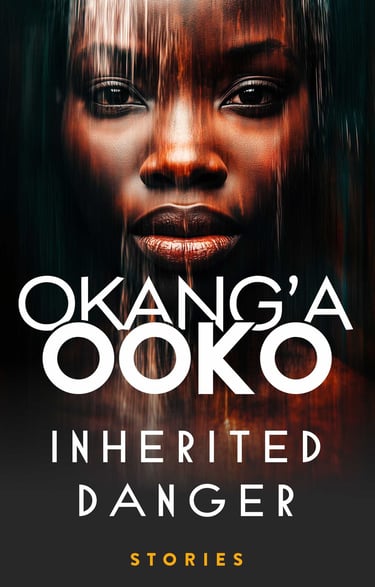
INHERITED DANGER


These eight compelling stories primarily center around resilient women leading in diverse environments such as their businesses, workplaces, and other challenging circumstances, alongside narratives exploring the struggles of Africans in their pursuit of survival.
In INHERITED DANGER, a ruthless activist-turned-politician must get married to her dead husband’s brother to save her organisation from the schemes of a shrewd competitor. AFTERMATH takes place in the guerilla-controlled Northern Uganda. Four girls fleeing into the forest to avoid being turned into sex slaves run into a bigger danger. In MONI AFINDA, a middle-aged brand manager carries the memories of her father’s failures into her business. She must win a contract at all costs and succeed because she cannot repeat her father’s mistakes. In KICHOROCHORO, a tumult of personal tragedies pushes a young social worker into the frontier of doom without a back-up plan. She throws herself into her work of reshaping the lives of ragamuffin homeless boys in a dangerous Nairobi slum. RUDE AWAKENING is about the return of Ajuang Nyar Kadem, the famous femme fatale in Luo lore. The haunting cinema-esque HAPPY 9TH BIRTHDAY is about a nine-year-old girl who is sexually abused by her father and its horrific aftermath. She throws the spanner into the works and into a nightmare of suspense and stark terror. The two last stories are about elderly musicians in a changing world. KISS YA BANGONGI is set in the degenerate world of Congolese music and demonstrates that chasing greatness spurs doubt, self hatred, failure, and pain especially when the conditions for greatness are deemed by the sort of egotistical man the protagonist is. In FIRST AND SECOND RHYTHM GUITARS IN AN OLD BENGA SONG, an old benga guitarist must drop his personal principles and give benga music a facelift in order to save it from extinction before he dies. The two stories are linked inextricably to innovation in the guitar music, to chord changes, and voiced heartaches.
CHAPTER EXCERPT
It is March again.
Odongo’s mind is filled with wisps of memories. Red and black silhouettes fast receding, no longer forming their story. Leaving only a faint, nervous residue of terror.
Recently, he took a depraved break to lead a phantom life after Opiyo’s death. And still, he is in a stupor, like a man waking from a hellacious dream. October is coming with its bitter memories that make him feel this strange, incredible force like the hand of the devil on the back of his head. Like a terrible phantasm. Isn’t it some kind of a miracle? That after all these years, he is still alive and limping along. Older now. Far more worldlier. Wiser, even. He rides a beat-up Raleigh bicycle with his good leg and his bad leg to Russia. His hands are callused, and his face is now a man’s face, and his hair is no longer the neat Afro; it’s now a tangled, thrashed, sunburnt mess the color of cow dung.
The death he yearns for has made him paranoid. Like a Kisumuan of yore, he has always hated Russia. Everything is full of memories of doom, mangy things, death. In March 2001, Kisumu is a new world. Now a “city”, ten times bigger than the postcolonial municipality of the 1970s, a once-laid-back happy town where the morning sunlight caressed your skin with its gentle sweetness as the children played. Which had classy establishments such as Mayfair, Wimpy, Mona Lisa, Nyanza Cinema, etcetera. Where your mother sent you on rundo gi rego maize-buying and milling errands at Pong Aida posho mill in Kibuye with the strict instruction, “Don’t line up after ja bel—someone with millet.” It has today transformed into a bustling cosmopolitan haven, surpassing even the vibrancy of Kampala. The lively streets, modest buildings, and happy faces tell tales of diverse origins, coming like a song on the radio. Kisumu, in this new fiction, is a harmonious blend of cultures, where dreams collide, and the rhythm of life plays out like a symphony, a kaleidoscope of diversity that paints the cityscape with hues from every corner of the world. Here, old decadence is swept away by fresh currents. Aspiring businesspeople, artists, retired politicians and civil servants, teachers and traders, young professionals—doctors, professors, nurses, hustlers like Odongo, tough women as hardened as Auma, all meet, mingle, hope, and live. To say the least, Kisumu looks like an old harlot, aged and haggard but trying to put on a girlish smile, with fine clothes. In it, Odongo is a man with a hard life. He remembers his twin brother Opiyo, who was older than he by five minutes. When twins are born, the first to come out is named Opiyo (meaning the fast one). The one who comes last is named Odongo (meaning the one who remains). If they are girls, the pair are named Apiyo and Adongo. How Kisumu destroyed him.
His last words: Take care of Auma. And saying that, the illness of this world killed him there, dead, as the medics stood by his carcass before the hospital bed in Russia. The nurses and the doctors, like psychiatrists and psychologists, like offal, flies to a feast, said things, all their cliches and their one-liners echoing their judgmental superiority. Before he died, Opiyo told Odongo that he had saved him from himself many times over the years. Their two years while he deteriorated were full of fond memories. Opiyo gave his brother his memories back. He gave Odongo back two of the hardest years of his life, taking care of him after his wife ran away. Odongo took away the prison in his brother’s mind, stolen away by morons who always got everything wrong. And Odongo remembers holding him while he coughed, giving him his medicine, and sitting him up to watch Saturday morning cartoons on the Sanyo television.
And Opiyo got saved and declared, “Lord, help me,” and asked his brother about his wife Auma.







BUY INHERITED DANGER FROM THESE RETAILERS

Bio
I'm Okang’a Ooko—a novelist and senior book designer with deep roots in publishing, storytelling, and design. I specialize in helping publishers and agents deliver polished, compelling books that resonate with their markets. Whether you’re producing high-volume titles or championing a first-time author, my design solutions ensure your books look as powerful as the stories they tell, captivating readers, and reflecting professional quality from cover to final page. As an author, my novels explore history, politics, culture, music, love, and identity—told through emotionally rich, character-driven narratives that captures nostalgia, societal conflict, and the personal struggles of those facing change and disconnection. Read more »
Ready to transform your story into something unforgettable? Okang'a Ooko specializes in end-to-end creative solutions for authors, publishers, literary agents, and storytellers. Whether you're crafting your first novel, launching a brand, or building an author platform, he's here to guide you from concept to creation. Learn more »
With decades of experience in storytelling, publishing, and visual design expertise. Ooko helps you bring your book, brand, or message to life—beautifully, strategically.
Turn your vision into a lasting impression. Hire Okang'a Ooko »
Hire Okang'a Ooko
Connect With Me
© 2026. All rights reserved.
Terms and Conditions I Refund Policy I Privacy Policy