
I sit at my desk feverishly typing, bringing Kisumo to a close. This hefty novel is a curious hybrid—half literary, half commercial. In writing it, I’ve learned the process is more ceremonial than functional. Often, I have so much to put into my journal. (I could have described the pleasures of the previous night; but that would have been confession, not chronicle; autobiography, not record.) A writer must write; but by my creed, he should remain detached—removed, objective, critical. I invoke Chekhov here: only the naive, the maudlin, write directly about themselves.
I’ve come to believe I’ve published books mostly because I enjoyed the life of a writer. I was hooked on the fringe benefits: the unhurried mornings, the dolce far niente, the company of my family, the delights of my wife, the rude interruptions of my sons. Yet there is always a reckoning—the day of the record, when I must balance my psychic accounts. Then I am obliged to tell my allotted story, to interpret for some casual reader the inward lives and delicate feelings of people I scarcely comprehend.
Gossip or lies?
Gossiper would have suited me better. Or lies, if a committed liar’s craft could ever be deemed a profession. But not writing. Sometimes we novelists are dumbfounded by the “lies” we tell. Novels are, in essence, built on lies. The novelist fabricates worlds, invents characters, and constructs events that never happened, yet we call it “truth” of another kind—emotional, psychological, or existential. To the casual observer, this might seem deceptive: why spend hours absorbing fictions when reality exists in abundance? Sometimes, the "lies" we novelists tell feel almost absurd—think of Superman leaping over skyscrapers, James Bond defying death with improbable gadgets, Dracula roaming moonlit castles, or Sherlock Holmes solving cases with impossible deduction. None of these figures ever lived; they are inventions. But their endurance proves something vital: these stories give us imaginative access to courage, cunning, fear, justice, or mystery in a way that bare facts cannot. Superman channels the longing for invincibility and moral clarity. Bond satisfies fantasies of sophistication and heroism. Dracula gives form to primal fears and forbidden desires. Holmes gratifies our faith that reason and intellect can triumph over chaos. But the “lies” of the novelist are deliberate and disciplined. They are lies that illuminate, clarify, and reveal aspects of the human condition that mere facts cannot. A novelist invents a character’s thoughts, yet in doing so, may capture the truth of millions of people’s inner lives. A plot that never happened can make the reader understand consequences and choices better than history itself. In this sense, fiction is a truthful lie—a paradox where what never was becomes the most accurate lens through which to see what is.
The power of these lies lies in their craft: the selection of detail, the shaping of emotion, the moral architecture of the story. A novelist tells lies, yes, but not for frivolity. Each lie is a tool, a mirror, or a lens, reflecting human desires, fears, and contradictions in ways reality often fails to do. To read a novel is to consent to be deceived in order to see more clearly. Lies, carefully told, can reveal truths more piercingly than any reportage or memoir.
Consider To Kill a Mockingbird by Harper Lee. Atticus Finch never existed outside Lee’s imagination. Scout and Jem never ran across the exact events she describes. Yet through this invented story, Lee exposes the realities of racism, moral courage, and social injustice in the American South far more vividly than a mere historical report might. The characters’ thoughts, fears, and triumphs are fictional—but they reveal universal truths about human nature, prejudice, and conscience.
The “lie” of the plot—the courtroom drama, the mysterious neighbor, the children’s adventures—is precisely what allows readers to emotionally experience these truths. Without the invention, the insight would be abstract; with it, it becomes lived, tangible, and unforgettable.
The evidence suggests the opposite: more novels appear each day, many outside traditional publishing. By any metric, the novel is in a kind of boom. The genre’s very expansiveness—its long arcs—makes it ripe for prequels, sequels, and spin-offs. Economically, novels remain a safe harbor for publishing houses; most all-time bestsellers are novels.
The enduring legacy of storytelling
More deeply, the novel endures because it draws on something profoundly human: storytelling. Since the dawn of language, we have told stories in every medium. Narrative is embedded in our nature, and perhaps that is why novels retain their hold. Even those who rarely read have loved at least one novel. When a form speaks to something so universal, how can it be “dead”?
Of course, storytelling has its pitfalls. Many 18th- and 19th-century novels deployed narrative to entrench the status quo. Fiction can repress as easily as it rebels. But that hardly means we should “kill” the novel. Rather, we should train ourselves to see the nuances—to recognize how a story can uphold and subvert ideology simultaneously. That is another reason the novel persists: it reveals the dual discourses hidden in narration.
Before Hemingway, The Classics
Before Hemingway popularized his sparse, journalistic prose, novel writing was often an expansive and elaborate art form. Authors like Mary Shelley, Charles Dickens, Anton Chekhov, the Brontë sisters, Gustave Flaubert, George Eliot, Leo Tolstoy, James Joyce, and George Orwell mastered a storytelling style rich with description, psychological depth, and social commentary. These writers were not afraid of length or complexity; they reveled in the slow unfurling of character and plot, layering meaning through language itself.
Mary Shelley fused gothic imagination with philosophical inquiry in Frankenstein, probing questions about creation and responsibility. Mary Shelley remains a remarkable stylist because her writing fuses intellectual depth, emotional resonance, and a mastery of language that feels timeless. In Frankenstein and her other works, she demonstrates an extraordinary ability to weave complex ideas—science, morality, creation, and responsibility—into prose that is both poetic and precise. Her sentences often flow with a lyrical rhythm, drawing on the Romantic tradition, but she balances this musicality with clarity and psychological realism. This duality allows her to move seamlessly from describing the sublime power of nature to the intimate, tormented emotions of her characters.
Shelley also stands out for her use of layered narratives and shifting perspectives, a structural elegance that enriches the reader’s experience. The nested storytelling in Frankenstein—Walton’s letters framing Victor’s confession, which in turn contains the Creature’s own voice—reveals her control over voice and tone, and her understanding of how point of view can deepen themes of empathy and alienation.
Moreover, she had a gift for evoking atmosphere; her descriptions of icy landscapes, stormy nights, and shadowed laboratories are vivid without being excessive. Unlike some of her Gothic contemporaries, her style doesn’t rely on melodrama; instead, she grounds her horror in human frailty and ethical conflict. This makes her work feel not only literary but also deeply human.
Dickens filled his novels with sprawling casts and vivid depictions of Victorian London, using satire and sentiment to challenge social injustices. Chekhov, though best known for his plays, pioneered the short story with quiet realism, revealing profound truths in ordinary lives. The Brontës infused their work with intense emotion and moral struggle, creating heroines like Jane Eyre and Cathy Earnshaw who remain iconic for their fierce individuality. Flaubert refined the art of psychological realism; his Madame Bovary dissected provincial boredom with sentences as precise as they were lyrical. Eliot’s Middlemarch explored the interconnections of a whole community, its moral and intellectual ambitions woven into the fabric of daily life.
Tolstoy stands as one of the greatest chroniclers of the human condition, blending intimate character portraits with sweeping historical epics. War and Peace and Anna Karenina are not only narratives of individuals but examinations of love, war, faith, and the rhythms of life itself. Joyce pushed form and language further still, proving with Ulysses that the interior monologue could be as dramatic as a battlefield. Orwell fused narrative craft with political urgency, showing that a novel could change how people view power, truth, and freedom.
In an interview with Lewis Nkosi in 1962, the Nigerian novelist Cyprian Ekwensi had this to say: “With regard to style, all of us owe something to Hemingway, I owe something to Steinbeck, Maupassant, Flaubert - all these are my favourite writers. But whenever I want to write and whenever I want to experience a certain humility I go back to Chekov and read him; sometimes I read Anna Karenina, I just read a part of Anna Karenina, either the brother who was very consumptive or Anna herself at the railway station going to be crushed by a train, and it's incredible the effect it has - it's a very deep sort of worship as far as I'm concerned.”
These pre-Hemingway and early modernist writers remind us that the novel has always been a flexible and evolving art. Their work demonstrates the enduring appeal of long-form storytelling: the immersion into another world, the engagement of intellect and emotion, and the chance to see humanity in all its contradictions. For writers like you, this lineage is both a heritage and a challenge. Craft still matters; there is a hunger for language that does more than relay events. Even in an era of screens and algorithms, the desire for layered, resonant stories—whether sprawling like Tolstoy or intimate like Chekhov—will keep readers turning pages.
James Joyce’s work endures because, even when it is challenging, it rewards readers with layers of meaning and an unmatched depth of innovation. His Ulysses is often cited as a pinnacle of the modernist novel—dense with allusions, experimental in structure, and revolutionary in its depiction of everyday life as epic. Though initially banned and derided as obscene, its humanity and wit have earned it classic status. Joyce takes the humdrum wanderings of Leopold Bloom and transforms them into an odyssey of consciousness, proving that the interior lives of ordinary people are worthy of epic attention.
Finnegans Wake, even more notoriously difficult, has endured for similar reasons but on a different plane. While Ulysses uses stream-of-consciousness and classical parallels, Finnegans Wake pushes language itself to its limits. It reads like a dream, built from portmanteau words, mythic references, and a cyclical narrative that mirrors the rhythms of human history and sleep. Many find it nearly impenetrable, yet its endurance in the canon rests on its audacity: Joyce dared to make language itself the protagonist. Scholars and readers continue to unearth new meanings from it, making it an inexhaustible text.
Compared to Ulysses, Finnegans Wake remains more niche—it’s less about storytelling in the conventional sense and more about exploring what narrative and language can do. Yet both have stood the test of time because they embody what defines a classic: works that challenge, provoke, and expand our imagination. Like Tolstoy’s sweeping moral epics or Dickens’s social panoramas, Joyce’s classics endure because they reveal new truths with every reading. They demand effort, but the payoff is immense: readers encounter the full potential of fiction, not as mere entertainment but as art that reshapes how we see the world and ourselves.
Enter Hemingway
Ernest Hemingway radically changed the landscape of modern literature by stripping language down to its bare essentials. His “iceberg theory,” or theory of omission—the idea that the deeper truths of a story lie beneath the surface of the words on the page—redefined how writers approach narrative. Instead of ornate Victorian flourishes, Hemingway delivered short, declarative sentences, lean descriptions, and dialogue that carried emotional weight through subtext rather than overt explanation. His prose mirrored modern life: fast-paced, fragmented, often ambiguous, yet deeply human. This minimalism resonated with a generation emerging from the trauma of World War I, giving voice to the disillusionment and restlessness of what Gertrude Stein famously dubbed the “Lost Generation.”
Alongside Hemingway, other towering American writers expanded the possibilities of literature in equally influential ways. F. Scott Fitzgerald, with The Great Gatsby and his other Jazz Age works, married lyrical elegance with biting social commentary, exploring themes of ambition, decadence, and the elusive American Dream. His sentences danced where Hemingway’s walked, yet both sought emotional precision. William Faulkner, in contrast, embraced a different modernist experiment—stream of consciousness, nonlinear time, and multiple perspectives. His novels like The Sound and the Fury and As I Lay Dying dig deep into the Southern psyche, showing how memory, history, and identity intertwine in ways that defy simple chronology. Faulkner’s influence is particularly evident in how contemporary authors experiment with structure and voice.
John Steinbeck offered yet another approach. His socially conscious works like The Grapes of Wrath and Of Mice and Men blended realism with a profound empathy for marginalized communities. His prose is accessible yet powerful, often elevating ordinary lives to the level of epic tragedy and moral fable. Saul Bellow, meanwhile, brought an intellectual rigor and psychological complexity to modern fiction, combining wit, moral inquiry, and urban consciousness. Works like Herzog and Humboldt’s Gift explore existential dilemmas, identity, and the inner turbulence of modern life with a precision that balances erudition and intimacy.
Jack London, though earlier than many of the modernists, contributed a raw, adventurous energy to American literature. Through novels like The Call of the Wild and White Fang, he fused naturalist observation with mythic storytelling, placing human and animal struggles against elemental forces, and demonstrating that narrative power could reside as much in action and environment as in introspective reflection.
Together, Hemingway, Fitzgerald, Faulkner, Steinbeck, Bellow, and London shaped the core of 20th-century American literature, each innovating in distinct ways. Hemingway’s minimalism, Fitzgerald’s lyricism, Faulkner’s psychological and structural complexity, Steinbeck’s social conscience, Bellow’s intellectual depth, and London’s elemental storytelling collectively gave modern literature its remarkable range. Their influence persists because they engaged with the universal—love, loss, injustice, yearning—while also experimenting with new forms of storytelling that still feel fresh, vital, and unmistakably human today.
Here comes technology
Reading, as a human practice, is not likely to be fully overtaken by AI or screen apps, though these technologies will inevitably shape how we consume stories. AI can summarize, analyze, and even generate text, while apps offer interactive, visual, and multimedia experiences that feel immediate and entertaining. Yet there are dimensions of reading that remain irreducibly human, and it is these that will continue to draw people to the written page.
To read is to engage the mind in ways that scrolling or passive consumption cannot match. A novel, an essay, a memoir demands sustained attention, imagination, and interpretation. It asks the reader to construct worlds, follow complex characters, and trace threads of meaning across pages—an active, rewarding labor of the intellect. Here, cognitive growth unfolds naturally, and satisfaction is earned in ways that pre-packaged summaries cannot provide.
Beyond cognition, reading offers a depth of emotional immersion. A finely wrought story allows us to inhabit the inner lives of others, to feel their doubts, their fears, their quiet triumphs. AI may simulate plot and dialogue, but it cannot convey the subtlety, nuance, and intimate resonance that a human author inscribes on the page. The pleasure lies not only in the narrative, but in the alchemy of empathy, where reader and character meet in private, silent accord.
There is also the simple, irreplaceable delight of language itself. Humans are drawn to rhythm, metaphor, and the precise arrangement of words. A beautifully written sentence, a lyrical paragraph, a carefully measured cadence offers aesthetic satisfaction that no algorithm can yet produce with true artistry. Reading is an act of interpretation and imagination: we fill in the spaces, envision faces, settings, and the cadence of action. AI and apps often pre-package these images, leaving less room for the mind to wander, to participate in the story-making itself.
Reading is intimate. It is a solitary act, a quiet space for reflection, for wandering thought, for disagreement with the text, for discovery. No feed, notification, or assistant can replicate this privacy, this space for thought. And beyond the personal, reading connects us to a larger human continuum. Books preserve voices and experiences across generations; they carry the authenticity of lived thought and emotion, the texture of history, the echo of human presence that AI may reproduce but cannot originate.
In the end, AI and screens may compete for our attention, but they cannot replace the full human experience of reading. A written text demands our focus, rewards our imagination, and opens a dialogue across time and space. It invites us to think, to feel, to participate. It remains, in all its quiet power, irreducibly human.
Is the novel dead?
When photography was invented, many declared the death of fine art. Painters and sculptors, they said, were obsolete—why render the world by hand when a machine could capture it with perfect fidelity? Yet painting and sculpture endured, transforming rather than disappearing. When the prose, the short story, the novel, and the printed magazine arrived, critics predicted the death of the theater; live plays would vanish before the written word. And still, the theater survived, thriving in ways the skeptics could not imagine. When cinema emerged, some claimed the death of fiction itself, as moving images promised more immediate storytelling than ink on a page. As a result everybody wanted to be a film maker. Hence the rise of Hollywood. And yet, novels remained, quietly insisting on their place in human life. The novel has lived side by side with film, compementing it as many novels are turned into movies.
No, the novel is not dead. It simply asks something of us that fleeting media rarely demands: attentiveness. It asks us to slow down, to peer beneath the surface, to savor language, nuance, and rhythm. Will the form ever die? I doubt it. There will always be readers who love novels beyond all else, who treasure the quiet intimacy of a story unfolding in their hands, the private dialogue between author and writer.
In Jane Austen’s day, families gathered to sing, to play the pianoforte or the harp, sharing music as a communal delight. Radio, recorded music, and new instruments altered those habits, but music itself did not die—it transformed, spread, and found new audiences. Today we consume more music than ever, in ways Austen could scarcely imagine. Novels are no different. Some watch films or television instead of reading, yet storytelling itself never dies. The medium may shift; the attention of audiences may wander; but the human hunger to inhabit another life, to feel another mind, to witness the inner workings of a heart, remains constant.
Even in a world of scrolling screens and fleeting images, the novel persists. It does not ask for our speed but for our attention; it offers not mere diversion but immersion; and when we surrender fully to it, the reward is revelation. This is the enduring power of fiction: it transforms the act of reading into an encounter with other lives, other worlds, and, ultimately, the deepest truths of our own.
Why do we still need novels?
Why do we still need novels? Years ago when I was in high school, I used to mock classmates for calling reading a hobby. To me, it was a necessary thing. I’d read a novel in two days. In thirty years since, I’ve read more than one thousand books: fiction, history, self-help. The impact on my life has been profound.
Here is why I now urge everyone to read (especially fiction):
Imagination – Unlike a film, where the director supplies the images, a novel forces you to conjure the scenes yourself. Your mind engages fully, enhancing comprehension and creativity.
Language and Expression – Reading enriches vocabulary and hones your ability to articulate complex ideas with clarity and elegance, bossts academic achievement, creativity, mental health, and critical thinking.
Efficiency – Most work involves reading. Habitual readers process text faster, making it easier to navigate documents, reports, and emails.
Identification – We often see ourselves in fictional characters. Any good novel spans emotions that echo our own, giving us solace that we are not alone.
Wisdom – Books by or about great figures teach lessons no movie could convey with such depth. Gandhi’s reflections, for example, reveal thoughts too intimate for film.
Empathy – By immersing ourselves in the lives and struggles of others, we expand our ability to understand perspectives far different from our own.
Focus and Patience – In a world of constant distractions, reading trains the mind to sustain attention and appreciate nuance rather than rushing to instant gratification.
Mental Escape and Peace – A good book offers a sanctuary from stress, a mental vacation that refreshes the soul while enriching the mind.
Other benefits abound. Reading stimulates cognition, expands vocabulary, reduces stress, improves focus, nurtures empathy, imparts knowledge, entertains, helps sleep, and fuels lifelong learning.
Psychologically, novels are more than diversion. They broaden perspective, calm the mind, and help connect disparate ideas over time. Knowledge compounds. It’s no wonder so many successful people swear by daily reading.
Think of reading as play, not labor. After a weary day, you don’t ask how anyone finds time to nap or watch TV; you simply need it. Likewise, novels are refuge: a portal into another world, a respite from the mundane. Books even surpass movies in one respect—you can inhabit a character’s inner world. When you witness their fears, losses, and triumphs, your own burdens shrink by comparison.
But what of the novelists themselves
The human authors are the laborers in language. Here, AI cannot trespass. Writing is deliberate construction. Every character, plot twist, and thematic motif is placed with intention—to echo, to subvert, to challenge reality. AI may assemble sentences, but it cannot intend, cannot embed commentary on society, politics, or psychology with genuine insight. Emotional resonance is another domain entirely. Readers recognize the depth born of experience: of suffering, dreaming, hoping, erring, and loving. AI-generated characters remain fundamentally artificial—they do not suffer or dream or feel.
Then there is voice and style: the fingerprint of consciousness. The tone, the rhythm, the cadence, the perspective—all emerge naturally from the novelist’s mind, evolving with the story. AI can mimic but cannot invent an original voice, nor follow its organic unfolding. Nor can AI conduct ethical and philosophical inquiry. Novelists wrestle with love, betrayal, existence, inequity, and wonder. AI can simulate but cannot interrogate or inhabit the moral questions of the human heart.
The novelist also surprises. We take risks: breaking narrative conventions, exploring moral ambiguity, presenting truths that unsettle. AI tends toward optimization and predictability; it rarely challenges, rarely unsettles. And finally, there is the ritual of writing itself. The slow, obsessive, meditative labor—the reading aloud, the revision, the listening for rhythm, the shaping of raw experience into art—is a space AI cannot occupy.
Conclusion
In short, the novel is alive and well on planet earth today. Books are guilty pleasures and serious teachers all at once. They transport, console, and enrich. They let you cry, laugh, rage, desire. They speak the language of dreams—because, truly, a novel takes place not on the page but in the mind.
AI and apps may alter the ways stories are consumed, but they cannot replace the human author. We do more than write; we create worlds, ethical dilemmas, emotional landscapes. We are the custodians of imagination, the guardians of a craft older than machines. The ritual persists. The mind persists. And the novel, with all its depth and fragility, persists with us.
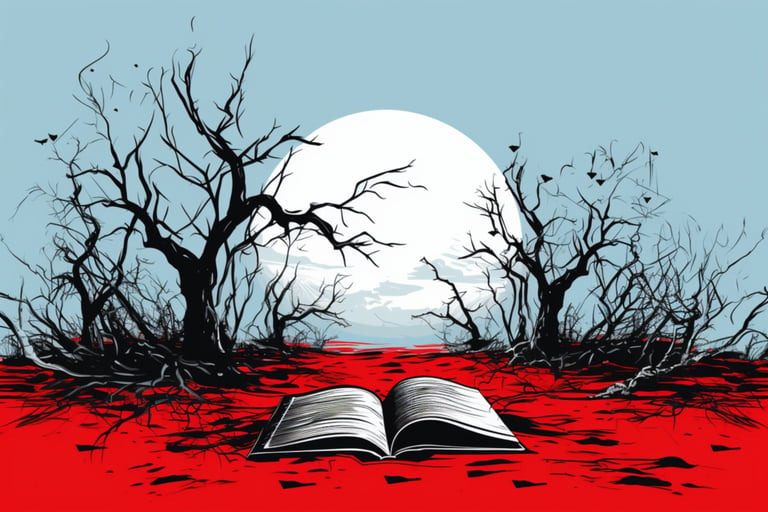
Is the Novel Dead?
Why Storytelling, Craft, and Human Imagination Still Defy Screens and AI
MA Y 2 0 2 6
