
As a graphic designer with more than twenty years of professional experience, I am often dismayed by the visual clutter that now floods our screens—work produced by inexperienced hands and AI-generated shortcuts that pile text and images together with little regard for the fundamental principles of graphic design. I am referring to principles such as harmony, unity, balance, rhythm, contrast, proportion, scale, hierarchy, and emphasis. These are not optional decorations. They are the foundations upon which effective visual communication is built.
What concerns me most is not AI itself, but the misleading message being promoted in some circles: that AI has somehow replaced graphic design.
It has not. Let me be clear. I am old-fashioned. By that, I mean I have profound respect for the ethics, discipline, craftsmanship, and professional standards of graphic design. I believe design still demands originality, responsibility, research, critical thinking, and creative judgment—not merely speed and automation.
I charge the old-fashioned way too: for expertise, not software. My rates begin at $68 per hour or from $300 for straightforward projects such as flyers, brochures, and book covers. I serve clients throughout the United States and Canada, and I bring to every project the same standards that guided my work in Nairobi decades ago.
Back then, I sometimes relied heavily on stock imagery and digital assets because clients could not afford custom illustration. But when a designer is compensated fairly, the quality of the work changes. There is time for research, refinement, experimentation, and sometimes even the creation of original illustrations and imagery from scratch.
Let me clarify something important. Art does not exist in a vacuum. Art borrows. It borrows from history, culture, language, architecture, symbolism, technology, traditions, and from other art forms. AI is simply another tool in that long lineage, much like clip art, stock photography, digital cameras, templates, and desktop publishing software before it.
The difference is that AI accelerates the process.
It does not replace the designer. I use the same tools many designers use today: Adobe Illustrator. Photoshop. InDesign. Midjourney. CorelDRAW. But software has never been the source of creativity.
Creativity resides in the human mind.
That is the biggest misconception surrounding AI.
AI can generate layouts, colour palettes, mockups, templates, and attractive visuals in seconds. It is a powerful assistant. But graphic design is not merely the arrangement of text and images.
Design is strategy.
Design is psychology.
Design is storytelling.
Design is branding.
Design is hierarchy.
Design is typography.
Design is cultural understanding.
Design is emotional intelligence.
Design is problem-solving.
AI can imitate aesthetics.
It cannot replace human judgment.
Clients do not hire professional designers because they cannot operate software. They hire designers because they need expertise in communication, audience behavior, market positioning, brand identity, readability, persuasion, visual consistency, print production, and creative direction. The dangerous illusion promoted by some AI evangelists is that generating a flyer with a prompt eliminates the need for designers.
It does not. Owning a calculator does not eliminate accountants. Owning a camera does not eliminate professional photographers. Using ChatGPT does not eliminate writers. Using AI does not eliminate designers.
What AI does is accelerate execution. A skilled designer using AI becomes faster, more productive, more experimental, and more efficient. AI assists with brainstorming, concept development, image generation, resizing, mockups, copy suggestions, presentation formatting, and repetitive production work.
It removes friction.
It does not replace intelligence.
In fact, AI-generated design often highlights exactly why professional designers remain essential.
Too often, AI-generated work suffers from:
weak typography
poor hierarchy
inconsistent branding
generic aesthetics
visual clutter
cultural inaccuracies
weak storytelling
poor print preparation
lack of originality
emotionless communication
Many AI-generated visuals are impressive for five seconds and forgettable forever after.
Real design is not decoration.
Real design is intentional communication.
The people achieving the most remarkable results with AI today are not those replacing designers.
They are experienced designers.
Why?
Because effective prompting itself requires visual literacy, creative direction, strategic thinking, and an understanding of design principles.
AI allows designers to spend less time executing repetitive tasks and more time refining ideas, solving communication problems, and creating original work. With AI, designers can focus on concept, strategy, storytelling, emotional resonance, cultural relevance, and originality instead of spending endless hours on production mechanics.
AI is not the death of graphic design. It is the evolution of the designer's toolbox. The future does not belong to those who reject AI. Nor does it belong to those who believe AI alone is enough. It belongs to designers who understand both design principles and AI tools—and who know how to combine them intelligently, ethically, and creatively.
Graphic Design and AI: A Designer's Perspective
A U G U S T 2 0 2 4
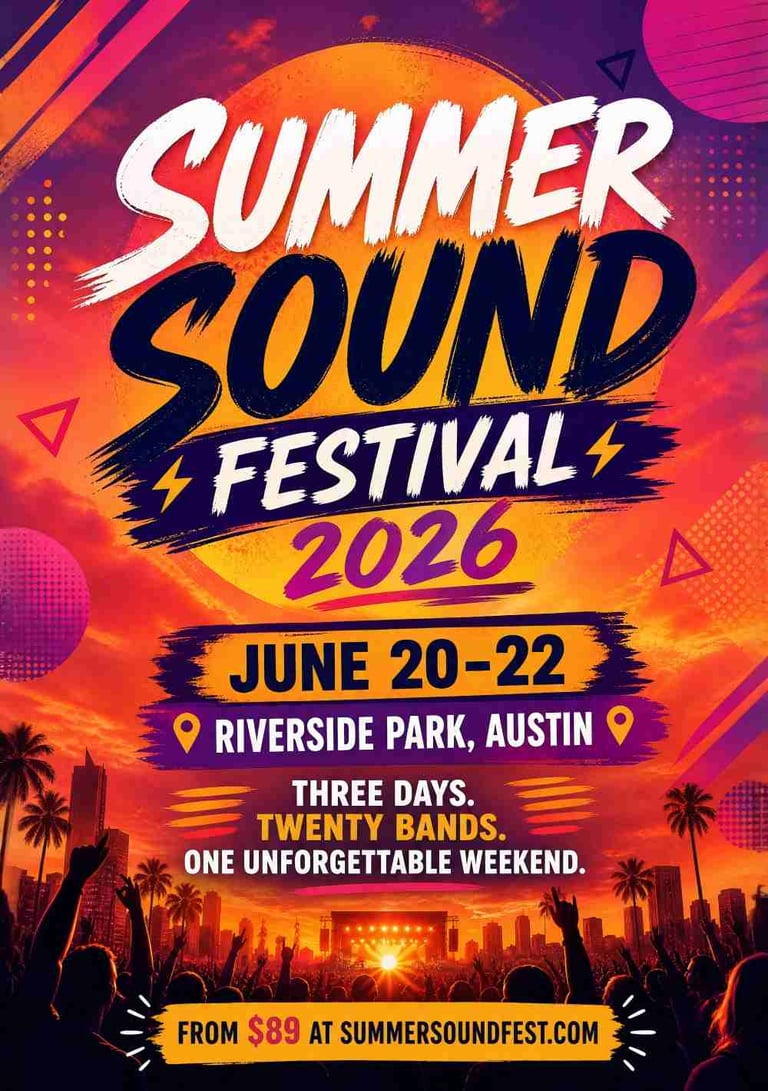
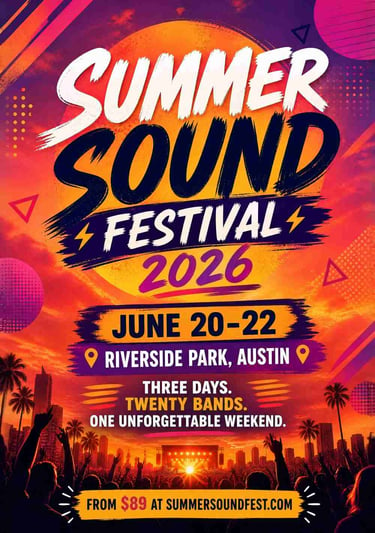


AI-generated flyer. Superficial design, visual clutter, weak typography, lack originality and/or character, no brand identity, loudness
Mock-up of a human-professionally-designer flyer. Clean design, clear brand identity, strong typography and clear brand identity
